
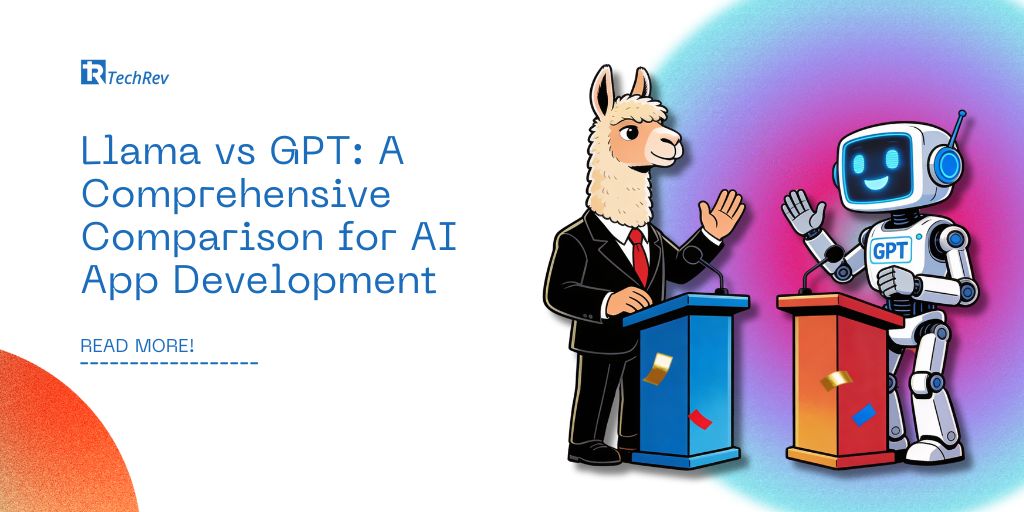
AI-powered products are now a core part of modern software. From SaaS platforms and enterprise automation to AI copilots and customer support tools, businesses actively rely on large language models to build intelligent features. Among all available options, Llama vs GPT has become one of the most important comparisons for startups, CTOs, and enterprises planning AI app development.
Choosing between Llama and GPT is not about model popularity. It is about cost control, AI app deployment strategy, scalability, and long-term business impact. This blog breaks down Llama vs GPT from a real-world, development-focused perspective.
What Is Llama and How Businesses Use It?
Llama is an open-weight large language model developed by Meta. Businesses can deploy Llama on private cloud infrastructure or on-premise servers, giving full control over data, performance tuning, and system architecture.
Companies use Llama when they need:
- Greater control over AI infrastructure
- Custom fine-tuning for specific domains
- Predictable long-term costs
- Strong data privacy and compliance alignment

Llama is commonly used in enterprise AI platforms, internal automation tools, healthcare systems, and regulated environments.
What Is GPT?
GPT models are proprietary large language models provided by OpenAI through APIs. They allow teams to integrate advanced language capabilities without managing infrastructure.
Why Is It Popular for AI App Development?
Businesses prefer GPT because:
- AI features can be launched quickly
- No infrastructure or GPU management is required
- Performance is strong across general use cases
- Ideal for MVPs, SaaS tools, and rapid experimentation
GPT is widely used for chatbots, AI copilots, content generation tools, and customer-facing custom AI solutions.
1. Llama vs GPT: Key Differences That Matter in Production!

When comparing Llama vs GPT, businesses must look beyond surface-level features.
1. Control and Customization
Llama allows deep customization and full ownership of the AI stack. GPT limits customization but simplifies development.
2. Speed to Market
GPT enables faster development cycles. Llama requires more setup but offers long-term flexibility.
3. Data Privacy and Compliance
Llama supports private deployment, making it suitable for sensitive data. GPT operates in managed environments, which may not fit all compliance requirements.
2. Llama vs GPT: Cost Comparison for AI App Development!
Cost plays a critical role when AI apps scale. GPT follows a token-based pricing model. Early-stage costs stay manageable, but expenses increase with usage. High-traffic AI applications often face margin pressure over time.
Llama requires upfront investment in infrastructure and deployment. However, once scaled, per-request costs become lower and more predictable.
Many companies start with GPT for validation and later migrate to Llama. TechRev regularly helps SaaS and enterprise clients plan this transition smoothly.
Also Read – LLM vs Generative AI: Choosing the Right AI for Your Business!
3. Llama vs GPT: for Startups, SaaS, and Enterprises
1. Llama vs GPT for Startups
Startups usually prefer GPT because it reduces development time and technical overhead.
2. Llama vs GPT for SaaS Companies
SaaS platforms often begin with GPT and later adopt Llama to optimize costs and improve customization.
3. Llama vs GPT for Enterprises
Enterprises prefer Llama for security, compliance, and infrastructure control. Hybrid architectures are also common.
Common AI App Development Challenges Businesses Face in 2026
Many teams underestimate production challenges such as:
- AI latency optimization
- Prompt engineering and evaluation
- Scaling inference workloads
- Monitoring AI outputs for reliability
- Cost control at scale
This is where working with an experienced AI development company becomes essential.
How TechRev Helps Businesses Build with Llama and GPT?
TechRev helps startups and enterprises design, build, and scale AI-powered applications using the right model strategy.
Our AI app development services include:
- LLM evaluation and architecture planning
- Llama deployment and fine-tuning
- GPT-based AI product development
- Hybrid AI system design
- Cost and scalability optimization
- Secure deployment and compliance alignment
TechRev builds AI systems that work in real-world production, not just demos.

Conclusion
The Llama vs GPT decision should be driven by business strategy, not hype. The right model depends on cost tolerance, data sensitivity, and long-term scalability goals.
If you are planning AI app development and need expert guidance, TechRev is ready to help.
Talk to TechRev today and build AI products that scale with confidence.
FAQs
1. Is Llama better than GPT for AI app development?
Llama works better for controlled, large-scale systems. GPT works better for rapid development and early-stage products.
2. Which is more cost-effective, Llama or GPT?
GPT is cheaper initially. Llama becomes more cost-effective at scale.
3. Can startups start with GPT and move to Llama later?
Yes. Many startups follow this exact path.
4. Is GPT safe for enterprise data?
GPT follows strong security practices, but some enterprises require private deployments.
5. Does Llama require more engineering effort?
Yes, but it offers greater long-term flexibility and control.
6. Can Llama and GPT be used together?
Yes. Hybrid AI architectures are common in enterprise systems.
7. How does TechRev support Llama vs GPT decisions?
TechRev evaluates business goals, costs, compliance needs, and scalability before implementation.
Also Read – Top Agentic AI Frameworks of 2026 Explained!